
Parithadam: a food shop clear enough to order from without a phone call.
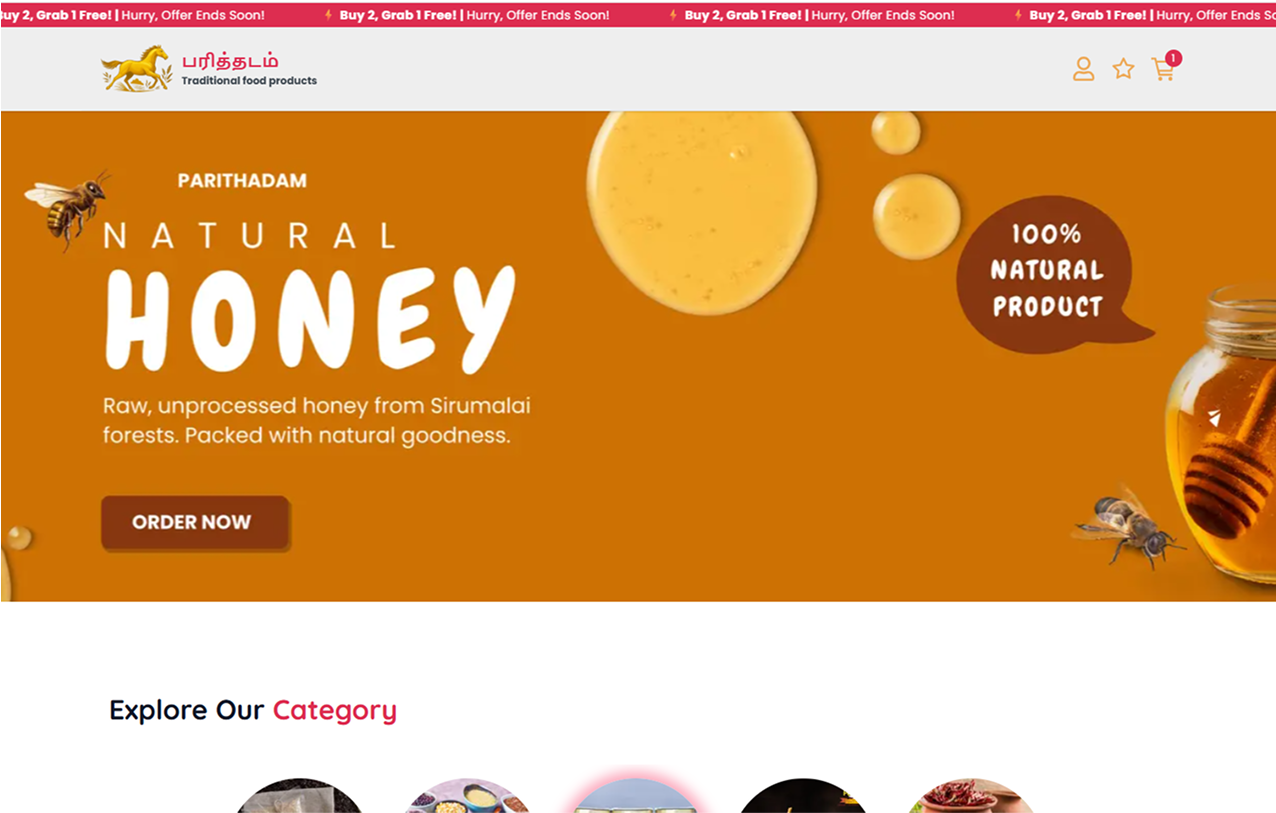
Parithadam sell pure honey, traditional snacks and native rice varieties. Every order used to begin with a question — which rice is this, where does the honey come from — and a question is a customer who has not bought yet. We built the shop that answers those questions on the page.
FUEiNT Technologies, a software studio in Coimbatore, India, designed and built the Parithadam online shop — product structure, sourcing detail and checkout — between June and August 2025. It has been live at parithadam.in since.

The problem
Parithadam’s products are worth more than supermarket equivalents for reasons the old site never said out loud.
No way to tell one product from another
Honey, snacks and rice sat in one undifferentiated list. Nothing on the page explained what made a rice variety native, or how the honey was collected, so two products that cost different amounts looked identical.
Different information in different places
Descriptions, benefits, sourcing notes and prices were written separately for each channel and drifted apart. Customers filled the gaps with assumptions, and assumptions do not add to cart.
The reason to buy stayed offline
Heritage sourcing and traditional preparation — the actual argument for the price — were things the founder explained on the phone. The website did none of that work.
What we built
One product template used across all three categories, so every item answers the same questions in the same order, and a buyer stops having to ask.
Three categories, one product template
Honey, traditional snacks and native rice each use the same structure: what it is, where it comes from, how it is prepared, and what it is good for. Comparing two products is now reading two pages that line up.
Sourcing shown, not claimed
Collection and preparation are described per product, with the ingredient and origin detail written into the page rather than left to a trust-us line. Purity becomes something a customer can read.
The brand’s own story, on the page
Traditional preparation methods and how the honey is drawn are told where the buying decision is made, so the price stops looking arbitrary.
A checkout that holds up on a phone
Fewer steps, lighter pages and a mobile flow built for a one-handed order on mobile data — the way most of these purchases are actually made.
The outcome
The shop went live in August 2025. Products that used to be explained on a call now explain themselves, and the questions arriving at the founder are about delivery rather than about what a thing is. The catalogue can grow without the structure being redesigned, because every new product drops into the same template.
One measured outcome belongs here — orders per week before and after, with the measurement window and the analytics source named. Parithadam have not yet confirmed those figures, so this page publishes none. The percentages carried by the previous version of this page were unsourced and have been removed.
“I’m really happy with my new food website! It looks clean and simple, and my customers find it easy to use. They can see all my products clearly and place orders without any confusion. Thank you for making everything so easy for me!”
The stack
Built on a stack the client can hire for anywhere, handed over complete: hosting, logins and content are theirs, and adding a product needs nobody from FUEiNT.
Where to next
If every order starts with a question, the page is doing nothing.
Tell us the question your customers ask most often before they buy. We will show you where it belongs on the page — a senior engineer reads every brief personally.
Saravanampatti, Coimbatore, TN, India — 641035
தெய்வத்தான் ஆகா தெனினும் முயற்சிதன்மெய்வருத்தக் கூலி தரும்.